Gujarat New Traffic Challan Rules: Unpaid Fines Could Suspend Vehicle Licence and Registration Services
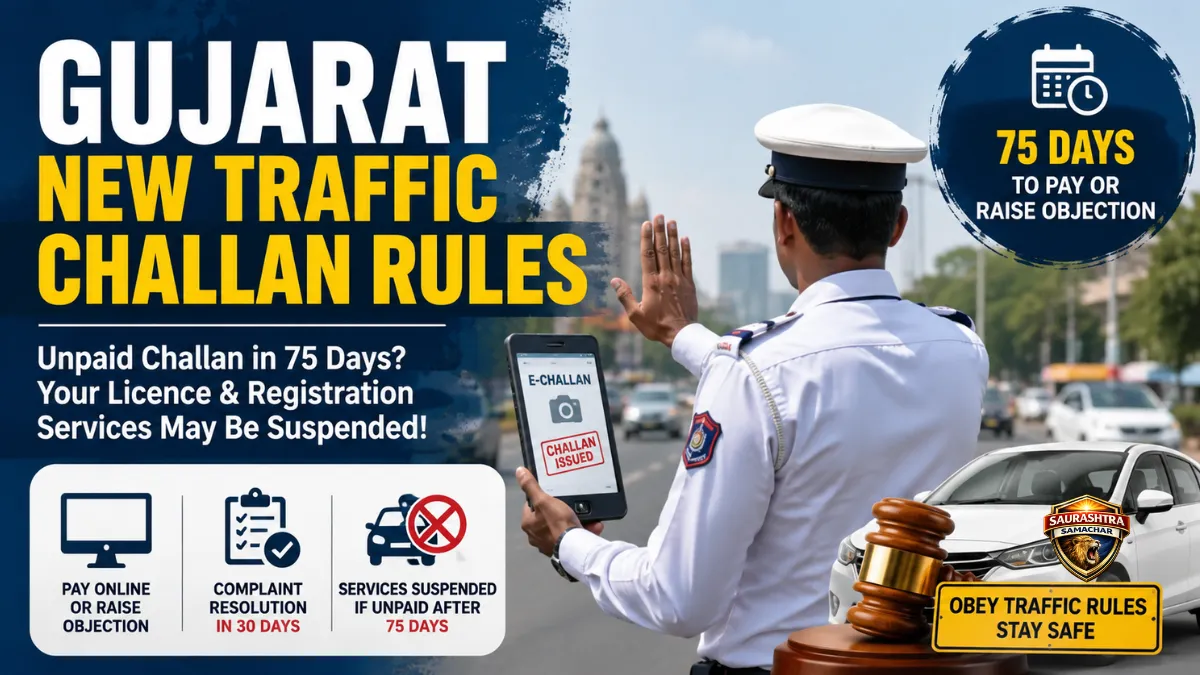
Gujarat New Traffic Challan Rules Come Into Effect From August 12
The Gujarat New Traffic Challan Rules have introduced a revised system for issuing, paying and challenging traffic fines across the state. The Gujarat Police has started implementing the new-generation challan system from August 12, with the aim of making traffic enforcement more transparent and ensuring that vehicle owners receive timely information about challans issued against their vehicles.
Under the updated system, motorists will also have a clearly defined process to raise objections if they believe a challan has been issued incorrectly. The authorities have established an online complaint mechanism through the Parivahan portal, where vehicle owners can submit their objections along with supporting documents.
One of the most important provisions of the new system is the 75-day overall timeline. If a challan remains unpaid after the prescribed period and the matter is not resolved through the objection process, services connected with the vehicle’s licence and registration can be suspended on the Parivahan portal.
Vehicle Owners Get 45 Days to Pay or Raise an Objection
According to information shared by State Traffic Branch SP V. Sahitya, vehicle owners will have 45 days from the date an e-challan is generated to either pay the applicable fine or raise an objection against it.
This gives motorists a specific window to check the challan details and decide whether they want to make the payment or challenge the violation.
If a vehicle owner believes the challan was issued incorrectly, there is no need to rely only on an offline complaint. The revised system allows the objection to be filed online through the Parivahan portal.
The vehicle owner will first need to ensure that an active mobile number is updated on the portal. This is important because SMS notifications related to the challan and the complaint will be sent to the registered mobile number.
After updating the mobile number, the vehicle owner can upload the relevant documentary evidence supporting the claim that the challan was wrongly issued. The complaint can then be submitted online for verification by the police authorities.
Complaints Will Be Examined Within 30 Days
The new system also sets a specific timeframe for dealing with objections. Once a complaint is received, the police department will examine the evidence submitted by the vehicle owner and take a final decision within 30 days.
The authorities have said that the entire process, starting from the generation of the challan and continuing through the complaint and its disposal, will be completed within a maximum period of 75 days.
This provision is intended to prevent complaints from remaining unresolved for an indefinite period and to give motorists clarity about the status of their challan.
If the police verification establishes that the challan was correctly issued, the vehicle owner will have to pay the applicable fine.
What Happens If the Challan Is Not Paid Within 75 Days?
The provision that could have the biggest impact on vehicle owners relates to unpaid challans.
If the 75-day period expires and the outstanding fine has still not been paid, all licence and registration-related services associated with the vehicle will be suspended on the Parivahan portal.
In practical terms, vehicle owners who leave an unresolved challan unpaid could face restrictions when trying to access services connected with their driving licence or vehicle registration.
The new provision therefore makes it important for motorists to regularly check whether any challan has been generated against their vehicle and take appropriate action within the specified timeframe.
Vehicle Owners Can Challenge Incorrect Challans Online
The revised system has also created a more structured mechanism for motorists who believe they have received a challan by mistake.
To raise an objection, the vehicle owner will need to visit the Parivahan portal and provide the required information. Supporting documentary evidence can be uploaded along with the complaint.
The complaint will then be examined by the designated police officials. The system is designed to ensure that objections are considered on the basis of available evidence rather than being left pending without a clear outcome.
Keeping an updated mobile number is particularly important because the vehicle owner will receive SMS updates concerning the challan and complaint process.
District-Level Officers Will Supervise Complaints
To ensure that complaints are examined quickly and impartially, the Gujarat Police has assigned responsibility to officers at the district level.
A Deputy Superintendent of Police (DySP)-level officer in each district will supervise the complaint resolution process. Under the supervision of the DySP, a Police Inspector (PI)-level officer will examine the evidence submitted by the vehicle owner.
The PI-level officer will be responsible for examining the documents and evidence and reaching a final decision on the complaint within 30 days.
The involvement of senior district-level officers is intended to create greater accountability in the challan objection process and provide vehicle owners with a defined mechanism for challenging disputed fines.
Also read:
Appeal in Court Is Also Possible
Vehicle owners who remain dissatisfied even after their complaint has been examined by the police will still have the option of approaching the court.
According to the new procedure, a vehicle owner who wants to pursue the matter in court after the police department’s decision can do so after depositing 50 percent of the challan amount.
This provides an additional legal route for motorists who do not agree with the outcome of the departmental complaint process.
New Challan System Focuses on Transparency and Compliance
The Gujarat Police says the new-generation challan system is aimed at improving transparency in traffic enforcement while making the process easier to understand for vehicle owners.
The revised system establishes specific timelines for payment, objections, verification and final disposal. It also provides motorists with an online platform to submit complaints and upload evidence without having to depend entirely on physical visits to police offices.
For vehicle owners, the key takeaway is to avoid ignoring an e-challan. Motorists will have 45 days to pay the fine or submit an objection, while the complaint verification process is expected to be completed within 30 days. The overall process will be limited to 75 days.
If the challan remains valid and the fine is not paid within the stipulated period, licence and registration-related services linked to the vehicle may be suspended through the Parivahan system.
The Gujarat New Traffic Challan Rules therefore place greater responsibility on vehicle owners to keep their mobile number updated, check challan notifications regularly, submit evidence when challenging a fine and complete the required process within the prescribed deadlines. The new framework is expected to bring a more structured approach to traffic challans while encouraging motorists across Gujarat to follow traffic rules and deal with violations promptly.
Also read: Passport Police Verification: Gujarat Police Ends Police Station Visits for Passport Applicants