Ahmedabad Mumbai Bullet Train Launch: India’s First High-Speed Rail Service Expected in August 2027
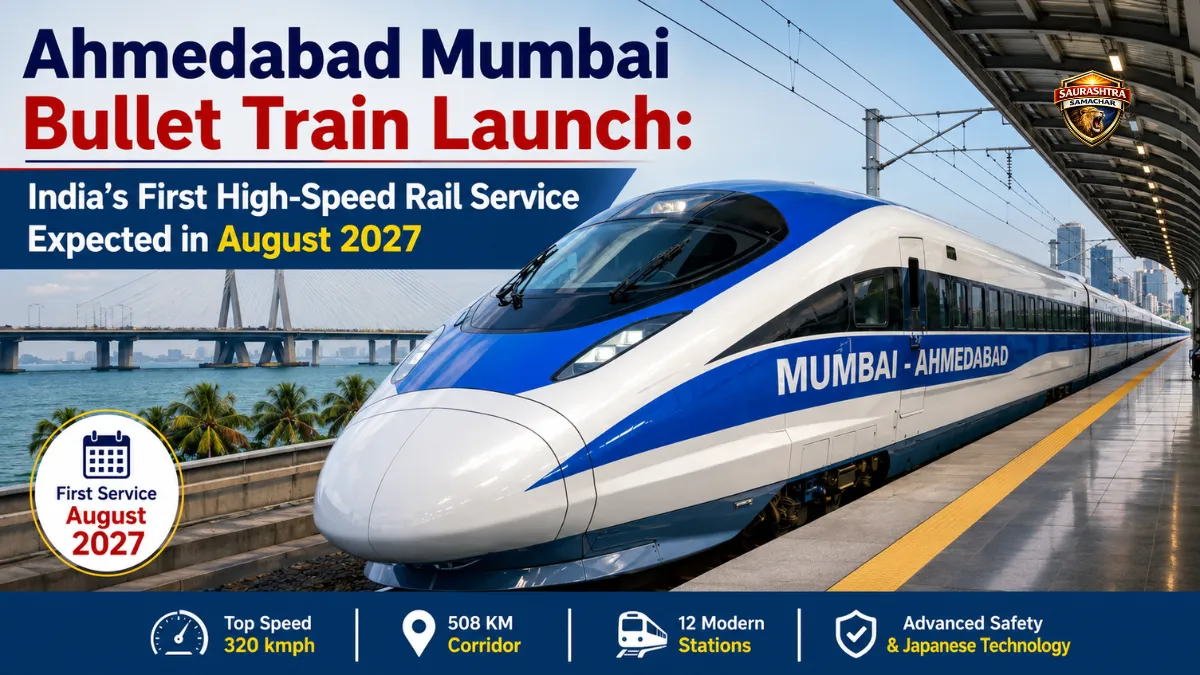
The Ahmedabad Mumbai Bullet Train project is moving closer to becoming a reality, marking a major milestone in India’s journey toward high-speed rail. The country’s first dedicated bullet train corridor is expected to begin its initial passenger service in August 2027, with the project being developed between Mumbai and Ahmedabad.
According to the latest information released by the government, the Mumbai-Ahmedabad High-Speed Rail (MAHSR) corridor is progressing rapidly, with the first section expected to open in 2027. Railway Minister Ashwini Vaishnaw has also said that the first phase of the bullet train service will begin in Gujarat in 2027.
The 508-kilometre corridor is being built with Japanese Shinkansen technology and is designed to provide much faster, safer and more comfortable inter-city travel. Once the entire route becomes operational, the journey between Mumbai and Ahmedabad is expected to take around 1 hour 58 minutes.
Ahmedabad Mumbai Bullet Train Launch Date and First Phase
The first bullet train service is expected to start in August 2027. Government documents have identified the initial section as part of the Gujarat stretch of the corridor, while Railway Minister Ashwini Vaishnaw has said that the Surat-Bilimora section is targeted for the first phase.
The Surat-Bilimora section covers roughly 47 kilometres and has reached an advanced stage of construction. Civil works and track-bed laying on this stretch have already made substantial progress, making it one of the most important sections ahead of the first commercial operation.
Recent government updates also indicate that around 80 per cent of the overall project work had been completed by July 2026. The plan is to progressively extend the service to other parts of Gujarat and eventually towards Mumbai.
508-Kilometre Mumbai-Ahmedabad High-Speed Rail Corridor
The Ahmedabad Mumbai Bullet Train corridor will cover approximately 508 kilometres across Maharashtra, Gujarat and the Union Territory of Dadra and Nagar Haveli.
The route has been designed for an operational speed of up to 320 kmph, while its design speed is 350 kmph. At these speeds, the project will represent a significant change in the way passengers travel between major cities in western India.
The corridor is being constructed using Japanese Shinkansen technology, including advanced track systems, signalling, train-control technology, electrification and safety systems.
12 Stations on the Bullet Train Route
The Mumbai-Ahmedabad corridor will have 12 planned stations connecting several major commercial and industrial centres.
The stations are:
- Mumbai BKC
- Thane
- Virar
- Boisar
- Vapi
- Bilimora
- Surat
- Bharuch
- Vadodara
- Anand
- Ahmedabad
- Sabarmati
These stations are being developed with modern passenger facilities and multimodal connectivity. The Ahmedabad station, for example, is being planned as an integrated transport hub connecting the bullet train with conventional rail, Metro and city bus services. Its design also draws inspiration from Ahmedabad’s famous kite culture.
Major Engineering Work Along the Route
One of the most striking features of the project is the scale of its engineering. A large portion of the 508-kilometre corridor is being constructed on elevated viaducts. This approach reduces the need for extensive land acquisition and helps the high-speed railway cross roads, railway lines and other obstacles without conventional level crossings.
The project also includes bridges, tunnels, viaducts, specialised track infrastructure and advanced electrification systems. As of March 2026, the government reported that around 430 kilometres of pier work and 341 kilometres of girder work had been completed.
Undersea Tunnel Near Mumbai
Another major engineering component is the tunnel being constructed in the Mumbai section. The project includes an undersea rail tunnel near Mumbai as part of the technically challenging approach to the city.
The Mumbai portion also includes the underground BKC station. Government updates have reported that foundation work for the underground station is nearing completion, highlighting the complexity of building the high-speed rail infrastructure within a densely developed urban area.
Also read: Chamoli Tunnel Collapse: 20 Workers Trapped Inside THDC Project Tunnel, 13 Rescued Safely
How Fast Will the Bullet Train Run?
The bullet trains on the Mumbai-Ahmedabad corridor will have an operational speed of up to 320 kilometres per hour. This is considerably faster than conventional Indian railway services and is designed to cut the travel time between Mumbai and Ahmedabad to about two hours.
The combination of high operating speeds, dedicated tracks, advanced signalling and Japanese high-speed rail technology is expected to make the journey considerably quicker than existing rail services.
Why the Ahmedabad Mumbai Bullet Train Project Matters
The project is important not only because it will introduce India’s first bullet train service but also because it is expected to create experience and technical expertise for future high-speed rail corridors.
The government has described the Mumbai-Ahmedabad project as a foundation for expanding high-speed rail in India. Engineers and technicians working on the project are gaining experience in areas such as viaduct construction, tunnelling, ballastless track installation, signalling, electrification and specialised railway operations.
The experience gained through this corridor could therefore play a role in the development of other high-speed rail routes planned across the country.
Also read: E20 Policy Sparks Political Row as Opposition, Transport Groups Demand Government Review
What Happens After the First Phase?
The launch of the first section in 2027 will be only the beginning of the larger project. The government has indicated that the service will be extended progressively along the corridor, eventually connecting the entire Mumbai-Ahmedabad route.
Once the full corridor is operational, passengers will be able to travel between the two major cities in around 1 hour 58 minutes. The route will also connect important business, manufacturing, tourism and commercial centres across Gujarat and Maharashtra.
The Ahmedabad Mumbai Bullet Train is therefore more than a new train service. It represents India’s first major step into dedicated high-speed passenger rail and is expected to influence future railway infrastructure, engineering capabilities and inter-city connectivity.
With construction moving ahead and the first service targeted for August 2027, attention is now focused on completing the remaining infrastructure and preparing the corridor for testing and passenger operations. If the current schedule is maintained, India could soon witness the beginning of a completely new era of high-speed rail travel.
Related News