E20 Policy Sparks Political Row as Opposition, Transport Groups Demand Government Review
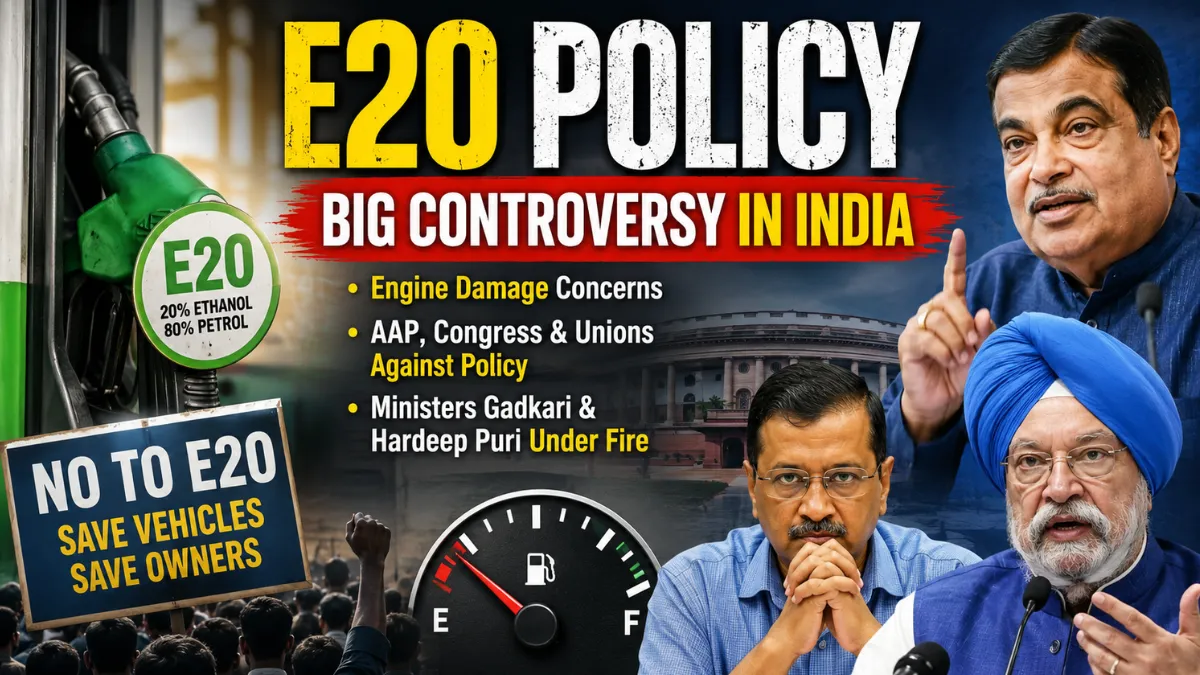
E20 Policy has become the center of a growing political and public debate in India, with opposition parties and transport associations intensifying their criticism of the government’s ethanol-blended fuel program. The controversy has gained momentum amid concerns that petrol containing 20% ethanol could affect vehicle performance, particularly in older models, while the government continues to defend the initiative as a key step toward reducing oil imports and strengthening India’s energy security.
The issue has now evolved beyond technical discussions about fuel compatibility into a broader political confrontation, with calls for protests, public consultations, and demands for accountability from senior Union ministers.
Opposition Launches Campaign Against E20 Policy
The Aam Aadmi Party (AAP) has announced a nationwide campaign opposing the E20 Policy, arguing that vehicle owners deserve greater transparency regarding the long-term impact of ethanol-blended fuel on engines and maintenance costs.
AAP national convenor Arvind Kejriwal has said the party will organize a “National Town Hall Against E20” on August 1 at Delhi’s Constitution Club. According to the party, the event will bring together automobile experts, transport professionals, vehicle owners, and citizens who believe they have been affected by the policy.
AAP also claims that an online petition demanding a review or withdrawal of the policy has received more than 200,000 signatures. Party leaders have stated that after the town hall meeting, they intend to submit the petition to Prime Minister Narendra Modi, urging the Centre to reconsider the implementation of E20 fuel.
The campaign is expected to focus on concerns related to engine compatibility, maintenance expenses, and the readiness of India’s existing vehicle fleet for higher ethanol blending.
Delhi Transport Unions Announce Parliament March
Adding to the pressure on the government, several transport organizations in Delhi have announced plans to hold a march toward Parliament on August 4.
The protest is being led by Sanjay Samrat, president of the Delhi Taxis and Tourist Transporters Association. According to the association, transport operators from different parts of the country have raised concerns about vehicle performance after the wider rollout of ethanol-blended petrol.
Union representatives argue that commercial vehicle owners, who rely heavily on their vehicles for daily income, should not be forced to bear additional maintenance costs if fuel-related issues arise.
However, the organizers have clarified that their protest is not affiliated with any political party and is intended solely to represent the interests of vehicle owners and transport operators.
Congress Seeks Action Against Union Ministers
The Congress party has also joined the criticism of the E20 Policy.
Uttar Pradesh Congress president Ajay Rai has written to Prime Minister Narendra Modi, calling for action against Union Road Transport and Highways Minister Nitin Gadkari and Petroleum and Natural Gas Minister Hardeep Singh Puri.
Congress leaders argue that before expanding ethanol-blended fuel programs such as E85 and E100, the government should first address concerns raised by millions of vehicle owners regarding the impact of E20 fuel.
The party has questioned whether sufficient safeguards and public awareness measures have been put in place before implementing the policy on a larger scale.
Gadkari Rejects Allegations, Says Policy Is Collective Government Decision
Union Minister Nitin Gadkari has strongly denied allegations linking the E20 Policy to personal or private interests.
Responding to claims circulated on social media, Gadkari said the ethanol blending initiative is a collective decision of the Government of India and not the decision of any individual minister.
He also challenged critics to present verified evidence showing that a vehicle engine had been damaged solely because of E20 petrol.
Meanwhile, the Bombay High Court has permitted Gadkari to pursue legal action regarding allegedly defamatory and manipulated content shared about him online. The court’s order allows legal proceedings against individuals responsible for spreading fake or deepfake material and includes directions concerning online platforms where such content appeared.
The legal proceedings are separate from the broader public debate surrounding the ethanol blending policy itself.
What Is the E20 Policy?
The E20 Policy refers to petrol that contains 20% ethanol and 80% conventional petrol.
Ethanol is a renewable biofuel primarily produced from sugarcane, maize, and other agricultural feedstocks. India has gradually increased ethanol blending over the past several years as part of its strategy to reduce dependence on imported crude oil and promote cleaner transportation fuels.
The government believes that greater ethanol blending offers several long-term advantages, including:
- Lower dependence on imported petroleum.
- Reduced foreign exchange spending on crude oil.
- Support for farmers through increased demand for agricultural feedstocks.
- Lower carbon emissions compared with conventional petrol.
Officials have consistently described ethanol blending as an important component of India’s broader energy transition strategy.
Why Has the Policy Become Controversial?
Despite the government’s stated objectives, concerns remain among some vehicle owners, transport operators, and automobile users.
Critics argue that many older vehicles were not originally designed to operate on fuel containing 20% ethanol. They claim prolonged use could potentially affect fuel system components such as rubber seals, plastic parts, and fuel lines because ethanol absorbs more moisture than conventional petrol.
Some vehicle owners have also expressed concerns about possible reductions in fuel efficiency and increased maintenance costs.
However, these concerns remain a matter of public debate. Vehicle manufacturers have issued varying guidance depending on the model year and engine specifications, and compatibility with E20 fuel differs across vehicles. Owners are generally advised to consult their manufacturer’s recommendations before using higher ethanol-blended petrol where compatibility is uncertain.
Government Stands Firm on Energy Security Goals
The Centre continues to defend the E20 Policy, describing it as an important reform that supports India’s long-term energy independence and environmental goals.
Government officials maintain that expanding ethanol blending can help reduce reliance on imported fossil fuels while encouraging cleaner and more sustainable energy sources. They have also highlighted the economic benefits for India’s agricultural sector through increased ethanol production.
At the same time, opposition parties and transport organizations are calling for a more cautious approach, arguing that consumer concerns should be addressed through transparent testing, public consultation, and clear technical guidance.
With AAP’s national town hall scheduled for August 1 and transport unions preparing their Parliament march on August 4, the debate over the E20 Policy is expected to remain in the national spotlight. Whether the government modifies its approach or continues with its existing roadmap may depend on how the public discussion and political pressure evolve in the coming weeks.
Related News