PM Narendra Modi Inaugurates Samrat Samprati Museum at Koba Tirth in Gandhinagar on Mahavir Jayanti
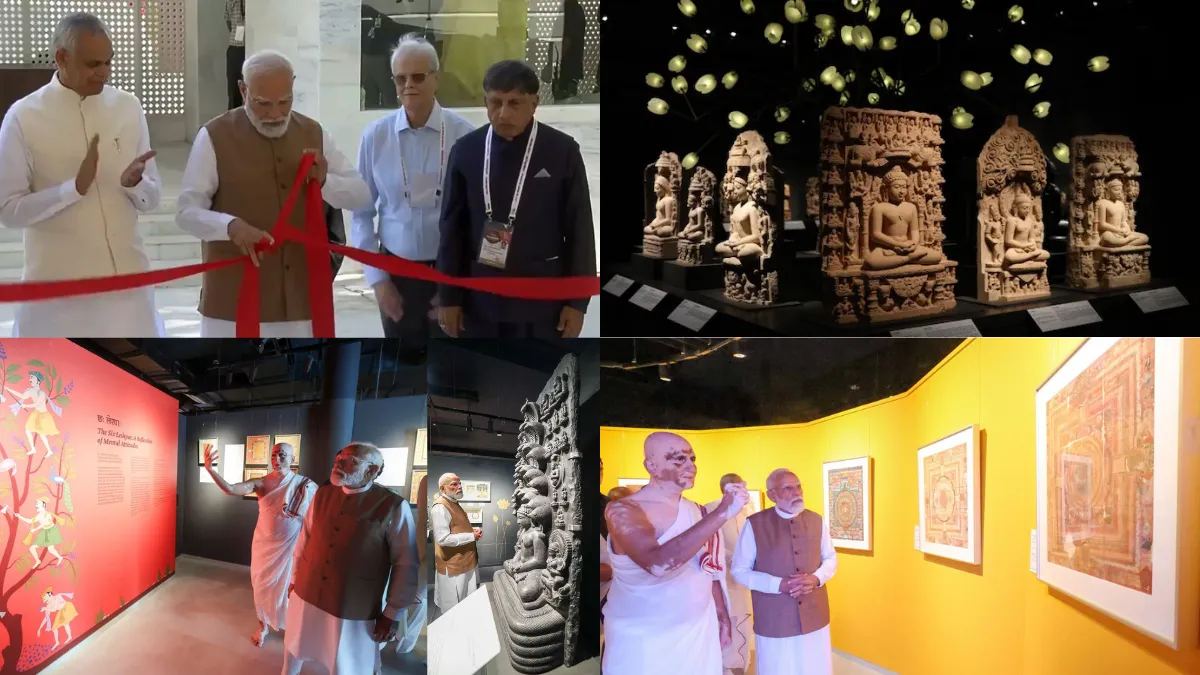
On the auspicious occasion of Mahavir Jayanti, Prime Minister Narendra Modi inaugurated the Samrat Samprati Museum at the sacred Jain pilgrimage site of Koba Tirth. The museum, officially named Samrat Samprati Sangrahalay – Jain Heritage Museum, stands as a monumental effort to preserve and showcase the spiritual, philosophical, and cultural legacy of Jainism and the broader traditions of Indian civilization.
Addressing the gathering during the inauguration ceremony, the Prime Minister described the Samrat Samprati Museum as a cultural treasure that represents India’s rich heritage and spiritual wisdom. He said the museum not only honors the legacy of Jain philosophy but also serves as a bridge connecting ancient values with modern generations.
The inauguration ceremony coincided with Mahavir Jayanti, making the occasion deeply symbolic for millions of followers of Jainism across India and around the world.
A Sacred Beginning: Tribute to Lord Mahavira
At the start of his address, the Prime Minister paid homage to Mahavira, whose teachings form the foundation of Jain philosophy.
“I bow at the feet of Lord Mahavira. From the sacred land of Koba Tirth, I extend heartfelt greetings of Mahavir Jayanti to all my fellow citizens,” the Prime Minister said.
Mahavir Jayanti marks the birth anniversary of Lord Mahavira, the 24th Tirthankara of Jainism. His teachings emphasize Ahimsa (non-violence), Satya (truth), Aparigraha (non-possessiveness), and Asteya (non-stealing)—principles that continue to influence millions of people worldwide.
The Prime Minister emphasized that the Samrat Samprati Museum represents the continuation of these timeless values and ensures that future generations remain connected to the philosophical depth of Jain Dharma.
The Samrat Samprati Museum is a must visit for all those passionate about history and culture. The Museum is a commendable effort to popularise Jain history, culture and teachings. pic.twitter.com/LNlmQ9hwX9
— Narendra Modi (@narendramodi) March 31, 2026
Koba Tirth: A Center of Spiritual Tranquility
The museum is located at Koba Tirth, a revered Jain pilgrimage site near Gandhinagar.
Prime Minister Modi described the site as a place filled with spiritual energy and serenity.
“Koba Tirth is a land of spiritual tranquillity. It is a sacred place where the tapasya and devotion of countless Jain monks and saints have flourished. Here, spirituality, creativity, and service naturally blossom,” he said.
For decades, Koba Tirth has been known as a hub for:
- Jain spiritual practice
- Scriptural studies
- Preservation of ancient manuscripts
- Social service and community work
The Prime Minister highlighted that traditions of study, self-discipline, and spiritual practice have been nurtured at this sacred site for generations.
The Foundation of Indian Civilization: Knowledge, Values and Culture
During his speech, the Prime Minister reflected on the foundations of Indian civilization.
According to him, India’s cultural strength lies in three fundamental elements:
- Preservation of values
- Nurturing of cultural traditions (Sanskar)
- Continuous pursuit of knowledge
He described these three aspects as a “Triveni”—a confluence that forms the core of India’s identity.
Maintaining this cultural flow, he said, is the collective responsibility of every citizen.
The Samrat Samprati Museum represents a significant step in preserving this cultural legacy.
Vision Behind the Samrat Samprati Museum
The idea behind the Samrat Samprati Museum emerged from Jain saints and scholars who wanted to present the ancient wisdom of Jain Dharma to modern audiences using contemporary museum technologies.
Prime Minister Modi said the museum reflects a grand vision: presenting centuries-old spiritual knowledge in a way that connects with today’s generation.
The museum aims to:
- Preserve Jain heritage
- Educate younger generations
- Encourage global research on Jain philosophy
- Promote India’s cultural diversity
He congratulated the Jain monks, scholars, and thousands of devotees who contributed to the creation of this cultural landmark.
Key Facts About the Samrat Samprati Museum
| Feature | Details |
|---|---|
| Museum Name | Samrat Samprati Sangrahalay (Jain Heritage Museum) |
| Location | Koba Tirth, Gandhinagar, Gujarat |
| Inaugurated By | Prime Minister Narendra Modi |
| Occasion | Mahavir Jayanti |
| Focus | Jain philosophy, Indian culture, ancient manuscripts |
| Galleries | 7 thematic galleries |
| Purpose | Preservation of Jain and Indian heritage |
Who Was Emperor Samprati?
The museum is named after Samprati, one of the most respected rulers in Indian history.
Emperor Samprati belonged to the Maurya Empire and is believed to be the grandson of Ashoka.
Prime Minister Modi highlighted that Samprati’s reign represented a rare example of spiritual leadership combined with political power.
Unlike many rulers who abandoned ideals when they gained power, Samprati used his authority to spread Jain values.
Key Contributions of Emperor Samprati
| Principle | Meaning | Contribution |
|---|---|---|
| Ahimsa | Non-violence | Promoted peaceful governance |
| Satya | Truth | Encouraged ethical administration |
| Asteya | Non-stealing | Advocated moral economic conduct |
| Aparigraha | Non-possessiveness | Promoted simplicity and detachment |
The Prime Minister noted that Samprati used his power as a form of service and spiritual practice, spreading the ideals of Jain philosophy across regions.
Seven Galleries Showcasing India’s Cultural Grandeur
One of the highlights of the Samrat Samprati Museum is its seven galleries that illustrate different aspects of Indian civilization.
Each gallery has been designed to provide visitors with an immersive understanding of Jain philosophy and Indian cultural diversity.
Overview of the Seven Galleries
| Gallery | Theme |
|---|---|
| Gallery 1 | Navpad and Jain spiritual principles |
| Gallery 2 | Jain philosophy and spiritual path |
| Gallery 3 | Life stories of Tirthankaras |
| Gallery 4 | Jain scriptures and manuscripts |
| Gallery 5 | Contributions of Jain Acharyas |
| Gallery 6 | Indian spiritual traditions |
| Gallery 7 | Cultural heritage and future inspiration |
The Prime Minister highlighted the first gallery, which explains the Navpad—a central concept in Jain spirituality.
Navpad Explained
| Element | Meaning |
|---|---|
| Arihant | Enlightened beings |
| Siddha | Liberated souls |
| Acharya | Spiritual leaders |
| Upadhyaya | Teachers |
| Sadhu | Monks |
These spiritual elements are complemented by the four pillars of righteous living:
- Samyak Darshan (Right Faith)
- Samyak Gyan (Right Knowledge)
- Samyak Charitra (Right Conduct)
- Samyak Tap (Spiritual Discipline)
Celebrating India’s Religious Diversity
The Prime Minister also highlighted that the Samrat Samprati Museum does not focus solely on Jain heritage but reflects India’s broader spiritual traditions.
The museum presents the harmony among several ancient traditions, including:
- Vedic philosophy
- Jain teachings
- Buddhist wisdom
- Yoga and Ayurveda traditions
“This museum reflects India’s greatest strength—unity in diversity,” the Prime Minister said.
He pointed out that while many parts of the world have experienced conflicts in the name of religion, India has historically embraced coexistence and mutual respect.
Lessons for a World Facing Conflict
The Prime Minister emphasized that the teachings represented in the Samrat Samprati Museum are highly relevant in today’s global environment.
Many parts of the world face tensions, conflicts, and ideological divisions. In such times, the values of non-violence, truth, and compassion taught by Jain philosophy can offer guidance.
He expressed hope that students, researchers, and visitors from around the world will visit the museum and take these teachings to every corner of the globe.
Preserving Ancient Manuscripts: A Monumental Effort
One of the most remarkable aspects associated with Koba Tirth is the preservation of ancient manuscripts.
Prime Minister Modi recalled how ancient Indian universities like:
- Takshashila
- Nalanda University
once housed lakhs of manuscripts before being destroyed during foreign invasions.
Despite those losses, ordinary citizens and monks preserved many manuscripts over centuries.
A major contributor to this preservation effort was Acharya Bhagwant Shri Padmasagar Surishwarji Maharaj.
For more than 60 years, he traveled across India searching for ancient manuscripts.
His dedication resulted in the preservation of over 300,000 manuscripts.
Manuscript Preservation at Koba
| Feature | Details |
|---|---|
| Total manuscripts preserved | 3,00,000+ |
| Materials | Palm leaves and birch bark |
| Age | Hundreds of years old |
| Preservation center | Koba Tirth |
| Purpose | Cultural and scholarly research |
The Prime Minister described this effort as an extraordinary service to India’s past, present, and future.
Government Initiative: Gyan Bharatam Mission
Prime Minister Modi also highlighted the government’s initiative to preserve manuscripts through the Gyan Bharatam Mission.
The mission aims to use modern technology to protect India’s ancient knowledge.
Objectives of Gyan Bharatam Mission
| Objective | Description |
|---|---|
| Digitization | Scanning ancient manuscripts |
| Preservation | Chemical treatment and restoration |
| Digital archiving | Online access for researchers |
| Survey | Identifying manuscripts across India |
The Prime Minister mentioned that citizens are encouraged to upload information about manuscripts they possess so that they can be preserved digitally.
India’s Cultural Renaissance
According to the Prime Minister, the creation of the Samrat Samprati Museum is part of a broader cultural renaissance taking place across India.
He highlighted several major heritage projects:
| Project | Location |
|---|---|
| Maritime Museum | Lothal |
| Vadnagar Museum | Gujarat |
| Yuge Yugeen Bharat Museum | Delhi |
These initiatives aim to showcase India’s history and heritage without political bias and present a truthful narrative of the nation’s past.
The Ten Resolutions for National Progress
During the event, the Prime Minister recalled the Navkar Mahamantra Divas celebration held in Delhi, where leaders from all four Jain sects came together.
He reiterated ten resolutions that citizens can adopt for national progress.
Ten National Resolutions
| No. | Resolution |
|---|---|
| 1 | Save water |
| 2 | Ek Ped Maa Ke Naam |
| 3 | Cleanliness mission |
| 4 | Vocal for Local |
| 5 | Desh Darshan |
| 6 | Natural farming |
| 7 | Healthy lifestyle |
| 8 | Yoga and sports |
| 9 | Helping the poor |
| 10 | Preservation of India’s heritage |
The Prime Minister said the Samrat Samprati Museum embodies these values, particularly the preservation of heritage.
Acharya Shri Kailasasagarsuri Gyanmandir’s Role
The Prime Minister also praised the work of Acharya Shri Kailasasagarsuri Gyanmandir, which has played a vital role in safeguarding ancient manuscripts.
In a message shared on the social media platform X, he expressed pride in the dedication of teams working to preserve India’s historical documents.
He wrote that such efforts ensure future generations remain connected with the country’s cultural roots.
A New Knowledge Hub for Future Generations
The Samrat Samprati Museum is expected to become an important destination for:
- Scholars of religion and philosophy
- Historians and researchers
- Students studying Indian culture
- International visitors interested in Jain heritage
By presenting ancient wisdom through modern technology, the museum creates an educational space where visitors can understand India’s spiritual legacy in depth.
Conclusion:
Prime Minister Modi concluded his address by expressing confidence that India’s cultural unity will continue to drive national progress.
He said when citizens work collectively for the goals of society and nation, development gains momentum.
The Samrat Samprati Museum, he said, will inspire generations to come and strengthen India’s cultural foundation.
“This museum will emerge as a major center of knowledge, spiritual practice, and cultural inspiration,” the Prime Minister said.